Iphigenia

Amidst the silent black ships on the shore
At Aulis came the princess to be wed.
And with bright eyes and cheeks a blushing red
heard she the bloody dowry father swore.
To feed the winds that bring the ships to war
With Huntress' altar for her marriage bed,
her bridegroom not a hero, noble bred,
but athame's blade, athirst for royal gore!

What courage, then, you gracefully displayed,
As into father's teary eyes you stared!
And while his shame he, trembling, tried to hide,
No tremors your adornments disarrayed.
Knew you then, as your pale neck you bared,
The goddess would a substitute provide?
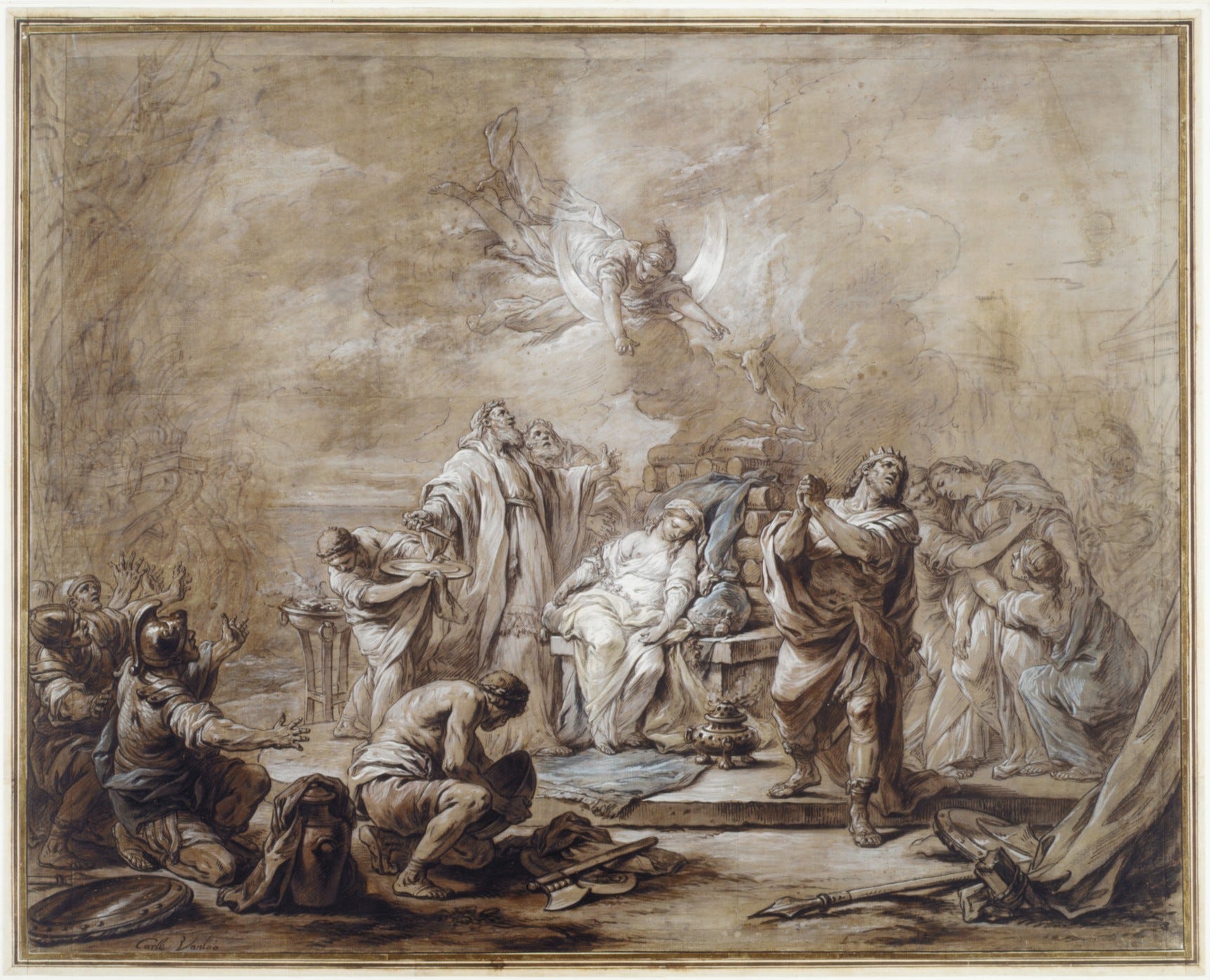
This is one of the many tragic stories surrounding the Trojan War. At the war’s outset, the Achaean fleet was gathering at Aulis before setting out against Troy. However, Agamemnon, the leader of the expedition, offended the goddess Artemis, and she stilled the wind, preventing the ships from launching.
The priest Calchas proclaimed that only the sacrifice of Agamemnon’s daughter, Iphigenia, would appease the goddess and allow the ships to depart. Agamemnon sent a message to his wife Clytemnestra, explaining that he had found a husband for Iphigenia and intended to hold a wedding at Aulis before the army set out to war.
Clytemnestra and Iphigenia arrived at Aulis eager to meet the groom but soon learned the truth. Iphigenia, however, bravely accepted her fate and went calmly to the altar. In most versions of the story, as Agamemnon brought the knife down, Artemis intervened and Iphigenia vanished, replaced by a deer. One of the more famous tellings of this story can be found in Euripedes’ Iphigenia at Aulis.
However, although Iphigenia was spared, many relationships were irreparably damaged and the anger and distrust sown here had disastrous consequences later on. In the tenth year of the war, at the beginning of the Iliad, Calchas announces that Agamemnon must return his war-prize Chryseis to her father, a priest of Apollo, in order to avert the plague that he had sent to punish the Achaean army. Agamemnon has already lost too much to the demands of Calchas and refuses to allow the girl to go without fair compensation.
For this “compensation” he demands Briseis, another war-prize belonging to Achilles. In some tellings, Achilles had been told he was to marry Iphigenia at Aulis before Agamemnon’s deception was revealed, so Briseis is not the first woman Agamemnon has deprived Achilles of. The deepening rift between Agamemnon and Achilles is the catalyst for the events that follow through the rest of the Iliad.
Finally, Agamemnon is murdered by Clytemnestra promptly upon his return from Troy. His willingness to sacrifice their daughter is the most commonly cited motivation. His son Orestes’ quest to avenge him, and the consequences thereof, make up the events of Aeschylus’s Oresteia.
I’ve always been drawn to the sharp contrast between Iphigenia’s courage and the cowardice of Agamemnon, who probably ought to have protected his daughter from the war-hungry Achaeans. I tried to capture some of that contrast in the poem. I found it a really fun challenge to try to tell the essentials of the story in something as small as a sonnet.
The deep, uneasy compulsion in the pattern of Atreus committing crimes against their own children becomes more and more horrifying and spectacular the more I learn about this story. I've just recently dived into the Oresteia. Agamemnon having his daughter killed to please his friends and start a war seems to me like a really compelling way to psychoanalyze the dark aspects of a father-daughter relationship
This is an excellent poem worthy of its subject.