Telamonides

Before the Argive ships great Ajax stands
By brother with the deadly, skillful eye.
He holds a mighty bulwark in his hands.

'Neath Teucer's arrows Trojan princes die.
Returning fire is caught on brother's shield,
And near enough to cut him none dare try

Since Ajax, as a fortress wall, won't yield,
He interposes self in brother's stead.
φιλία dominates the battlefield.


Teucer stands with eyes a weeping red
Against the men who once called brother friend
but would deny the honor due him dead.

No Trojan spear brought Ajax to his end.
No sword or arrow makes his brother mourn,
But unearned hate from those he'd once defend.

Now Teucer faces cruel Atreides' scorn,
Who to his brother proper tomb refuse,
Demands the Greeks a victor's grave adorn.


Though ages pass and memories diffuse,
Still brothers' love is honored by the Muse.
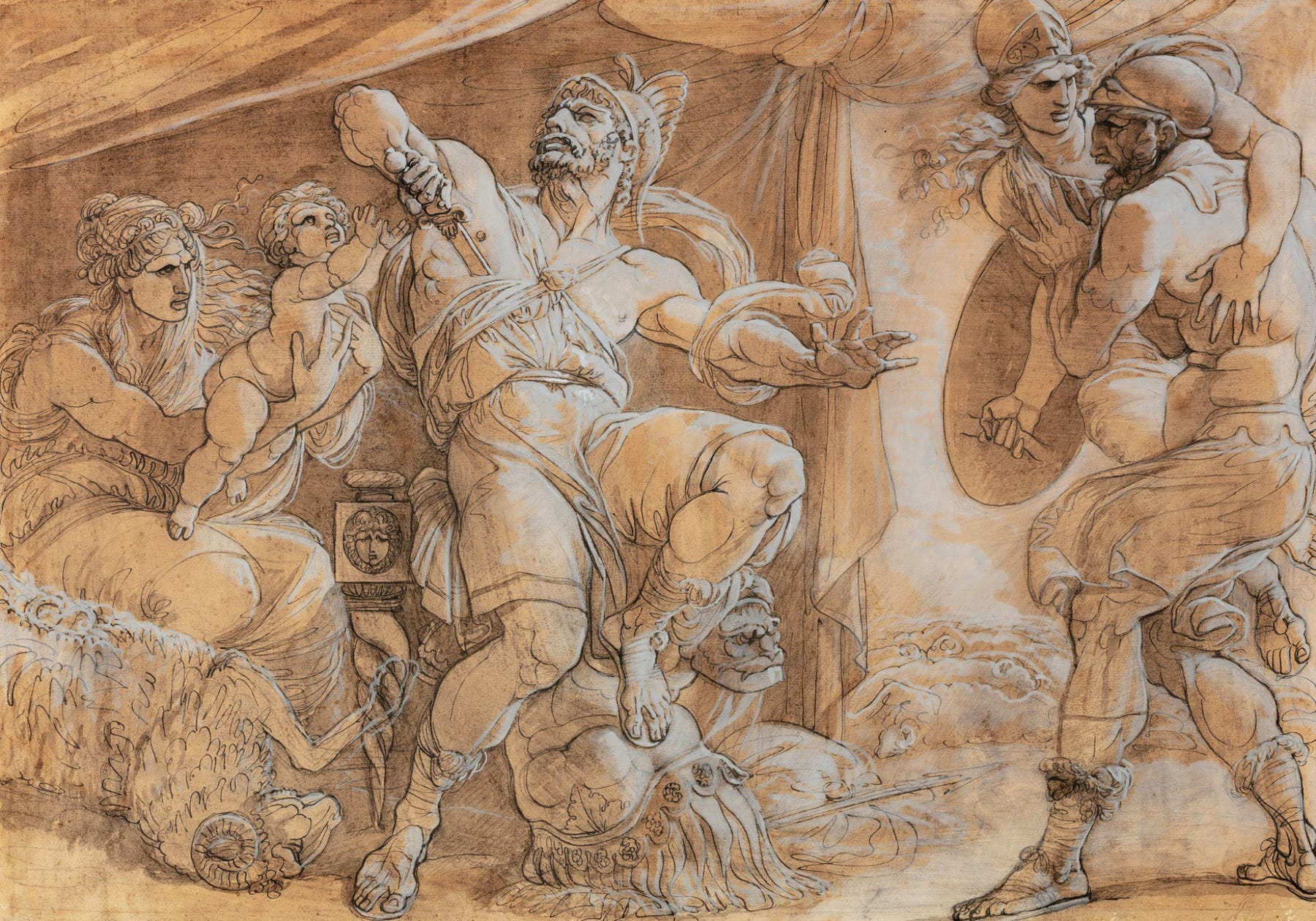
The sons of Telamon, Ajax1 and Teucer, fought together on the Achaean side during the Trojan War. Although they were only half-brothers in a time where such relationships often ended in bitter rivalry, their actions demonstrated a touching brotherly devotion to each other.
Ajax was one of the strongest Achaean warriors, second only to Achilles. He dueled Hector, the Trojan champion, to a stalemate and on several occasions he defended the bodies of his fallen comrades from Trojan looters. He turned back the Trojan assault on the vulnerable Achaean camp while Achilles abstained from battle.
Ajax would fight alongside Teucer, the Achaean’s best archer. While Teucer shot down Trojan warriors with his bow, Ajax would stand over him with his massive shield protecting him from enemy fire. None could stop Teucer’s arrows without contending first with Ajax, so the pair made a deadly combination on the battlefield.
Tragically, Ajax’s contributions to the war effort were ultimately unrecognized by his comrades. At the end of the war, Menelaus and Agamemnon, who led the Achaean force, awarded the fallen Achilles’ armor to Odysseus. Odysseus had developed the strategy that ultimately won the war, the famous Trojan Horse, but Ajax felt slighted, since he was not only the strongest warrior left alive, but he was also Achilles’ cousin and the armor likely held significant sentimental value to him.
Sophocles wrote, in Ajax, that Ajax then was driven mad by Athena. He slaughtered a herd of cattle, having hallucinated that they were Odysseus, Agamemnon, and Menelaus. When he came to his senses, he was so filled with shame at what he had done, compounded with how he had been dishonored by his comrades, that he killed himself.
Teucer had been warned of this by a premonition from the prophet Calchas, but arrived at Ajax’s side too late to prevent the tragedy. Agamemnon and Menelaus wanted to deprive Ajax of an honorable funeral and leave him unburied, to be eaten by scavengers. Teucer alone stood in defense of his brother, arguing passionately on his behalf against the most powerful kings in Greece. He refused to relent, protecting Ajax in death as Ajax had protected him in life. Finally, the kings gave in and a great tomb was built to honor Ajax’s remains.2
The Greek word φιλία (philia) used in the poem above refers to the love between siblings, or sometimes very close friends. I recently had the occasion to reflect on my own relationship with my brother, and this is what initially brought this topic to mind. This poem, therefore, is lovingly dedicated to him.
Not to be confused with Ajax, son of Oileus
During the reign of the Roman emperor Hadrian, it was claimed that the tomb of Ajax was discovered near Rhoiteion, a town in the neighborhood of ancient Troy. It was said that the remains inside were of a man 11 cubits tall, or 16.5 feet! For comparison, the biblical Goliath was “only” 6 cubits and a span, around 9.8 feet tall.